Where Is Ha Giang? How to Get There from Hanoi, Sapa & Other Destinations
Where Is Ha Giang?
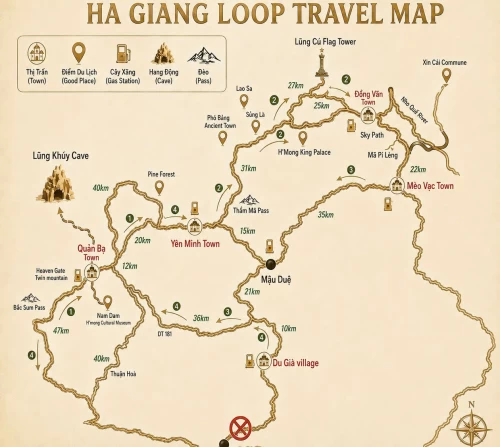
Ha Giang is located in the far north of Vietnam, close to the Chinese border. For travelers planning the Ha Giang Loop, Ha Giang City is the main gateway and the place where most tours begin and finish.
Looking at a map, Ha Giang may not appear particularly far from Hanoi. The road distance is roughly 300 kilometers, but traveling in northern Vietnam is not always comparable to covering the same distance on a European motorway. Traffic, road conditions, mountain terrain and scheduled stops all affect journey time, so getting to Ha Giang requires some planning.
Unlike destinations such as Hanoi, Da Nang or Ho Chi Minh City, Ha Giang does not have a major commercial airport. There is also no direct train service to Ha Giang City. For most international visitors, this means the final part of the journey will be by road, usually by bus, limousine or private transfer.
The good news is that Ha Giang is now well connected with several popular destinations in northern Vietnam. Hanoi remains the easiest and most common starting point, but travelers can also reach Ha Giang from Sapa, Ninh Binh and other tourist areas without necessarily returning to Hanoi first.
Getting from Hanoi to Ha Giang
For most first-time visitors, Hanoi to Ha Giang is the most straightforward route. There are multiple departures throughout the day and evening, with different vehicle types available depending on your budget and preferred level of comfort.
The journey normally takes around six to seven hours, although actual travel time can vary depending on traffic, departure point, weather, vehicle and stops along the way. Because the journey takes a significant part of the day, many travelers choose an evening or overnight departure.
The three most common options are sleeper bus, limousine and private transfer. Each has advantages, and the best choice depends largely on how you prefer to travel.
Sleeper Bus from Hanoi to Ha Giang
Sleeper buses are one of the most popular ways to reach Ha Giang, particularly among backpackers and travelers trying to maximize their sightseeing time.
Instead of conventional upright seats, sleeper buses have reclining or lie-flat-style berths. Depending on the vehicle, these may be standard sleeper beds or more private cabin-style spaces. Services often depart Hanoi in the evening and arrive in Ha Giang late at night or early in the morning.
The main advantage is efficiency. Rather than using most of a day traveling north, you can leave Hanoi after sightseeing and arrive in Ha Giang before the Loop begins.
There is, however, an important trade-off: sleep quality.
Some travelers sleep perfectly well on sleeper buses. Others barely sleep at all. Road movement, stops, lights and the unfamiliar sleeping position can make the journey uncomfortable, especially for taller travelers.
Starting several days in the mountains after a poor night of sleep is not always ideal. If you know that you struggle to sleep on buses, saving a hotel night may not be worth arriving exhausted.
Sleeper buses are therefore best for travelers who prioritize budget and time efficiency and are comfortable with overnight road travel.
Limousine from Hanoi to Ha Giang
A limousine service is another popular option and generally provides a more conventional seated journey.
In Vietnam, the word “limousine” usually refers to an upgraded passenger van rather than the long luxury vehicle travelers may imagine. These vehicles typically have fewer and more comfortable seats than standard buses, often with greater personal space.
For travelers who dislike sleeper buses, a daytime limousine can be a good alternative. You can sit normally, watch the scenery change as you travel north and arrive in Ha Giang in the afternoon or evening.
The disadvantage is that the journey uses a significant portion of your day. However, this can be worthwhile if arriving rested is more important than maximizing every sightseeing hour.
Limousines are particularly suitable for couples, mature travelers and visitors who value comfort but do not need a fully private transfer.
Private Transfer from Hanoi to Ha Giang
A private transfer offers the greatest flexibility and privacy.
Instead of following a fixed bus schedule, the vehicle can usually collect your group at an agreed location and travel directly toward Ha Giang. This can be particularly convenient for families, groups of friends or travelers arriving at Hanoi airport who want a smoother connection.
Private transfers also make it easier to manage luggage and stop when necessary. You do not need to share the vehicle with a large group or adjust to multiple passenger pickup points.
Naturally, this option costs more than shared transportation. For one solo traveler, the difference can be significant. For a family or group splitting the cost, however, a private transfer can become much more reasonable.
It is worth considering not only the price but also the value of convenience, especially after a long international flight or when traveling with older family members.
Should You Travel During the Day or Overnight?
This is one of the most important decisions when traveling from Hanoi to Ha Giang.
An overnight journey is efficient. You can spend the day exploring Hanoi, leave in the evening and wake up in Ha Giang. For travelers with limited time in Vietnam, this can effectively save a day.
A daytime journey is less efficient on paper but often more comfortable. You arrive in Ha Giang at a reasonable hour, have dinner, organize your belongings and sleep in a proper bed before beginning the Loop.
Neither option is always better.
If you sleep easily on buses and have a tight itinerary, overnight travel makes sense. If you already know that overnight transport leaves you exhausted, consider traveling earlier and protecting your first day in Ha Giang.
The Loop itself is the experience you came for. Arriving rested enough to enjoy it is more valuable than saving a few hours on paper.
Arriving in Ha Giang Before Your Tour
Whenever possible, it is useful to understand what happens between arriving in Ha Giang City and actually beginning the Loop.
Many travelers arrive the evening before departure. This gives them time to check in, shower, reorganize luggage and sleep before starting the mountain journey the following morning.
Travelers arriving very early after an overnight bus may have several hours before the tour starts. Depending on the arrangement, there may be somewhere to rest, shower or have breakfast, but this should be confirmed in advance rather than assumed.
When booking transportation and a tour separately, check where the bus will drop you off and where your tour begins. Some services terminate at a bus station, while others may offer hotel or operator drop-off depending on the ticket and vehicle.
A little coordination at this stage prevents a surprisingly common problem: arriving in an unfamiliar city at 3 a.m. and only then trying to work out where to go.
Getting from Sapa to Ha Giang
Travelers exploring northern Vietnam often want to combine Sapa and Ha Giang. The two destinations offer very different experiences, so visiting both can work well if you have enough time.
Direct road connections are available between the two areas, although schedules and vehicle types can vary. The journey is long enough that it should be treated as a travel day rather than a quick transfer.
The major advantage of traveling directly from Sapa to Ha Giang is that you do not need to return to Hanoi. On a northern Vietnam itinerary, this can save considerable backtracking.
For example, a route such as Hanoi → Sapa → Ha Giang → Hanoi is generally more logical than returning to Hanoi between every destination.
Because departure schedules can change, especially outside peak periods, travelers should confirm their Sapa–Ha Giang transfer close to their travel date.
Should You Visit Sapa Before or After Ha Giang?
There is no universal correct order.
If your international journey begins in Hanoi, you can travel to either destination first and connect to the other afterward. The better order usually depends on transport schedules and what you plan to do after Ha Giang.
Travelers continuing south through Vietnam may find it convenient to finish Ha Giang and return to Hanoi before heading toward Ninh Binh, central Vietnam or an airport connection.
Those planning a longer northern journey can combine Sapa and Ha Giang with additional destinations without repeatedly returning to the capital.
The key is to look at the whole route rather than planning each destination separately.
Getting from Ninh Binh to Ha Giang
Ninh Binh and Ha Giang are another popular combination. Ninh Binh offers rivers, limestone formations and countryside scenery, while Ha Giang provides a much more extensive mountain road-trip experience.
Travel between the two is possible by road, including services that allow travelers to avoid an overnight stay in Hanoi. However, availability and schedules can vary, and some services may involve pickups, transfers or intermediate stops.
A direct or connecting Ninh Binh–Ha Giang service can make sense when your itinerary is tight. If the available connection is inconvenient, traveling through Hanoi may sometimes be simpler.
Do not choose a route purely because it is labelled “direct”. Compare departure time, total journey duration, arrival time and vehicle type. A slightly longer connection that gets you to Ha Giang at a sensible hour can be more comfortable than an awkward direct service.
Getting from Ha Long or Cat Ba to Ha Giang
Combining Ha Long Bay or Cat Ba with Ha Giang is possible, but the distance makes this a relatively long transfer.
Some travelers try to move directly between the two regions to avoid returning to Hanoi. This can save backtracking, but it is important to check the actual journey rather than simply looking at the map.
Depending on current transport services, the trip may involve a direct tourist bus or a connection. Cat Ba adds another logistical element because travelers first need to leave the island.
If your schedule allows, returning through Hanoi can sometimes create a more comfortable itinerary. If time is limited, a direct northern connection may be worth considering.
The best option depends heavily on current transport schedules, so this is one route where checking close to your travel date is especially important.
What About Cao Bang?
Ha Giang and Cao Bang are increasingly combined by travelers who want to explore more of northern Vietnam. Cao Bang is best known internationally for Ban Gioc Waterfall, but the province also offers extensive mountain scenery and quieter rural areas.
Traveling between Ha Giang and Cao Bang by road takes time because both regions are mountainous. This should be treated as part of a longer northern Vietnam journey rather than a quick transfer between neighboring attractions.
For travelers with enough days, combining the two can create an excellent extended route through Vietnam’s far north. For visitors with limited time, concentrating on one region may provide a better experience than spending too many hours transferring between destinations.
Which Transport Option Is Best?
For most travelers, the choice can be simplified.
Choose a sleeper bus if saving money and daytime hours is your priority. Choose a limousine if you prefer a comfortable seat and do not mind using part of the day for travel. Choose a private transfer if privacy, flexibility and convenience matter most.
Your choice may also change depending on who you are traveling with. A solo backpacker may find a sleeper bus perfectly practical, while a family of four may find the convenience of a private vehicle worth the additional cost.
There is no need to choose the same transport in both directions. For example, you might take an overnight sleeper bus to Ha Giang to save time and return to Hanoi by daytime limousine when you are tired after completing the Loop.
What Should You Do With Your Luggage?
One of the most common questions first-time visitors ask is what to do with their large suitcase while completing the Loop.
If you are returning to Ha Giang City after the tour, taking your entire Vietnam luggage into the mountains is usually unnecessary. A smaller bag containing clothes, toiletries, medication, electronics and valuables is much easier to manage.
Ask your tour operator or accommodation whether secure luggage storage is available before departure. This is especially important for travelers using motorbikes, where carrying a large suitcase is impractical.
Packing a small Loop bag before leaving Hanoi can make arrival much easier. Instead of opening your entire suitcase early in the morning, you already have everything needed for the next few days.
How Much Time Should You Leave After the Loop?
Avoid planning a tight connection between finishing the Ha Giang Loop and an important international flight.
Mountain journeys are affected by weather, road conditions and traffic. The transfer from Ha Giang back to Hanoi also takes several hours.
If your flight leaves Hanoi immediately after the planned return from Ha Giang, even a relatively small delay can create unnecessary stress.
Whenever possible, leave a reasonable buffer before international flights or other bookings that cannot be changed. Spending one final night in Hanoi is often much more relaxing than watching the clock throughout the last day of your Loop.
Common Transport Mistakes to Avoid
A common mistake is looking only at departure time and ignoring arrival time. A bus leaving Hanoi at 9 p.m. may sound convenient until you realize it arrives in Ha Giang in the middle of the night. Always check what happens after arrival and whether somewhere to rest is available.
Another mistake is assuming that “limousine”, “VIP bus” and “cabin bus” have universal standards. Vehicle layouts and service levels vary between operators, so photographs and recent information are more useful than the category name alone.
Travelers should also avoid planning overly tight connections. A bus arriving in Hanoi shortly before a flight or train leaves very little room for delays.
Finally, do not forget to confirm pickup and drop-off points. Hanoi is large, and “Hanoi pickup” does not necessarily mean pickup from every hotel or from the airport.
Making Ha Giang Fit Naturally Into Your Vietnam Trip
Getting to Ha Giang is easier when you think about the journey as part of your overall itinerary rather than an isolated transfer.
If you are beginning in Hanoi, the capital provides the simplest connection. If you are already in Sapa or Ninh Binh, check whether continuing directly to Ha Giang makes more sense than returning to Hanoi. If Ha Giang is followed by a flight or a long journey south, build enough buffer into the return.
A well-designed itinerary reduces unnecessary backtracking and, more importantly, prevents you from arriving at the Loop already exhausted.
The goal is not simply to reach Ha Giang as quickly as possible. It is to arrive in a condition where you can enjoy what you traveled there to experience.
Getting to Ha Giang with Wings
For guests booking a Wings Ha Giang Loop Tour, transport planning does not need to be complicated. Let us know where you will be before the tour, your preferred travel time and whether comfort or budget is the bigger priority, and we can help you identify a suitable transfer option.
Guests arriving before the Loop can also plan their arrival around their tour start rather than booking transport blindly and discovering afterward that the timings do not work well together.
If you are combining Ha Giang with Sapa, Ninh Binh or another destination in northern Vietnam, share your wider itinerary with us. Sometimes a small change in the order of destinations can save hours of unnecessary travel.
Once your transport is arranged, the next question is usually the most important one: how many days should you actually spend on the Ha Giang Loop?
That is exactly what we will cover in the next Wings guide.
Ride Beyond. Discover Ha Giang.